
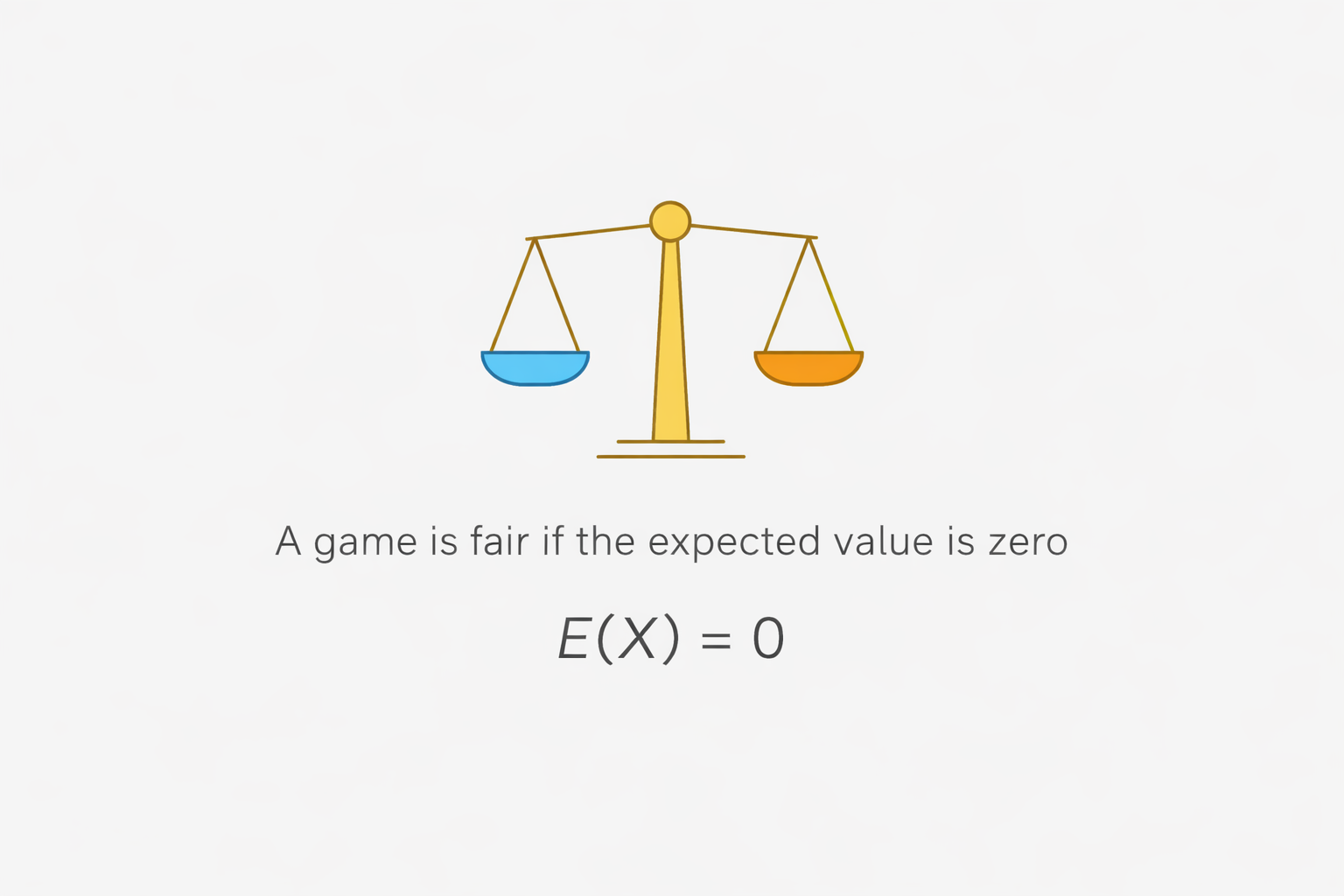
A Game Is Said to Be Fair If the Expected Value Is Zero
When someone says “This game is fair”, they usually mean “I won once.”
In mathematics, fairness doesn’t care about feelings, luck, or one-time wins.
A game is said to be fair if the expected gain or loss is zero.
That single sentence is the foundation of every probability question related to fair and unfair games. Let’s break it down in a simple, logical, and exam-friendly way.
What Does “Fair” Mean in Probability?
In everyday language, a fair game feels balanced.
In mathematics, a fair game is balanced—numerically.
A game is considered fair when:
Neither player has a long-term advantage
The average outcome over many trials is zero
Expected gain equals expected loss
Important:
Fair does not mean you always win
Fair does not mean equal results every time
Fair means no profit and no loss in the long run
The Key Rule: Expected Value Decides Fairness
The fairness of a game depends entirely on expected value (EV).
Expected Value (Simple Definition)
Expected value is the average result of a game if it is played repeatedly over time.
Expected Value = (Outcome × Probability)
If:
Expected Value = 0 → Fair Game
Expected Value > 0 → Player advantage
Expected Value < 0 → Unfair game (house advantage)
This principle is widely accepted in probability theory and applied in exams, statistics, economics, and real-world decision-making.
Mathematical Condition for a Fair Game
A game is said to be fair if and only if:
Expected Gain = Expected Loss
In other words:
The money you expect to win
Equals the money you expect to lose
This condition ensures long-term balance, regardless of short-term results.
Example 1: A Fair Coin Toss Game
Game Rules:
Heads → Win $1
Tails → Lose $1
Probability:
P(Heads) = ½
P(Tails) = ½
Expected Value Calculation:
EV=(½×+1)+(½×−1)=0EV = (½ × +1) + (½ × −1) = 0
Conclusion:
This is a fair game because the expected value is zero.
Example 2: An Unfair Dice Game
Game Rules:
Roll a 6 → Win $5
Roll 1–5 → Lose $1
Probability:
P(6) = 1/6
P(Loss) = 5/6
Expected Value Calculation:
EV=(1/6×5)+(5/6×−1)=0EV = (1/6 × 5) + (5/6 × −1) = 0
This version is fair.
But if the reward drops to $4:
EV=(1/6×4)+(5/6×−1)=−1/6EV = (1/6 × 4) + (5/6 × −1) = −1/6
Now the game is unfair.
A small payout change can destroy fairness—this is why understanding expected value is critical.
Why Most Real-Life Games Are Not Fair
Casinos, betting platforms, and lotteries are designed to be unfair.
Why?
A fair game makes no money
Even a tiny negative EV guarantees profit over time
Repetition favors the house
This is not opinion—it’s mathematical fact.
How an Unfair Game Can Be Made Fair
A game can be adjusted to become fair by:
Increasing the reward
Reducing the loss
Changing probabilities
That’s why fair games are mostly found in:
Math textbooks
Probability exams
Classroom examples
Why This Topic Is Important for Exams
Questions like:
“Determine whether the game is fair”
“Find the expected value”
“Adjust the prize to make the game fair”
appear frequently in probability chapters (Class 9–12 and beyond).
Common student mistake:
Assuming a game is fair because winning seems possible.
Final Takeaway: Fair Games Are About Math, Not Luck
Let’s summarize:
A game is said to be fair if expected value is zero
Fairness appears over the long run
Winning once doesn’t prove fairness
Most real-world games are intentionally unfair
Expected value is the ultimate decision-maker
If a game sounds “too good to be true,”
the math already knows the answer.
Want solved exam-style questions on fair games?
Need short notes or revision material for probability?
Looking for step-by-step expected value problems?